
PILATES EQUIPMENT GUIDE
What Is Reformer Pilates Good For? Uses, Benefits and Limits
A reformer adds a moving carriage and spring resistance to Pilates exercises. Here is what that can help you practise, what depends on the instructor, and how to assess equipment for a home or studio.
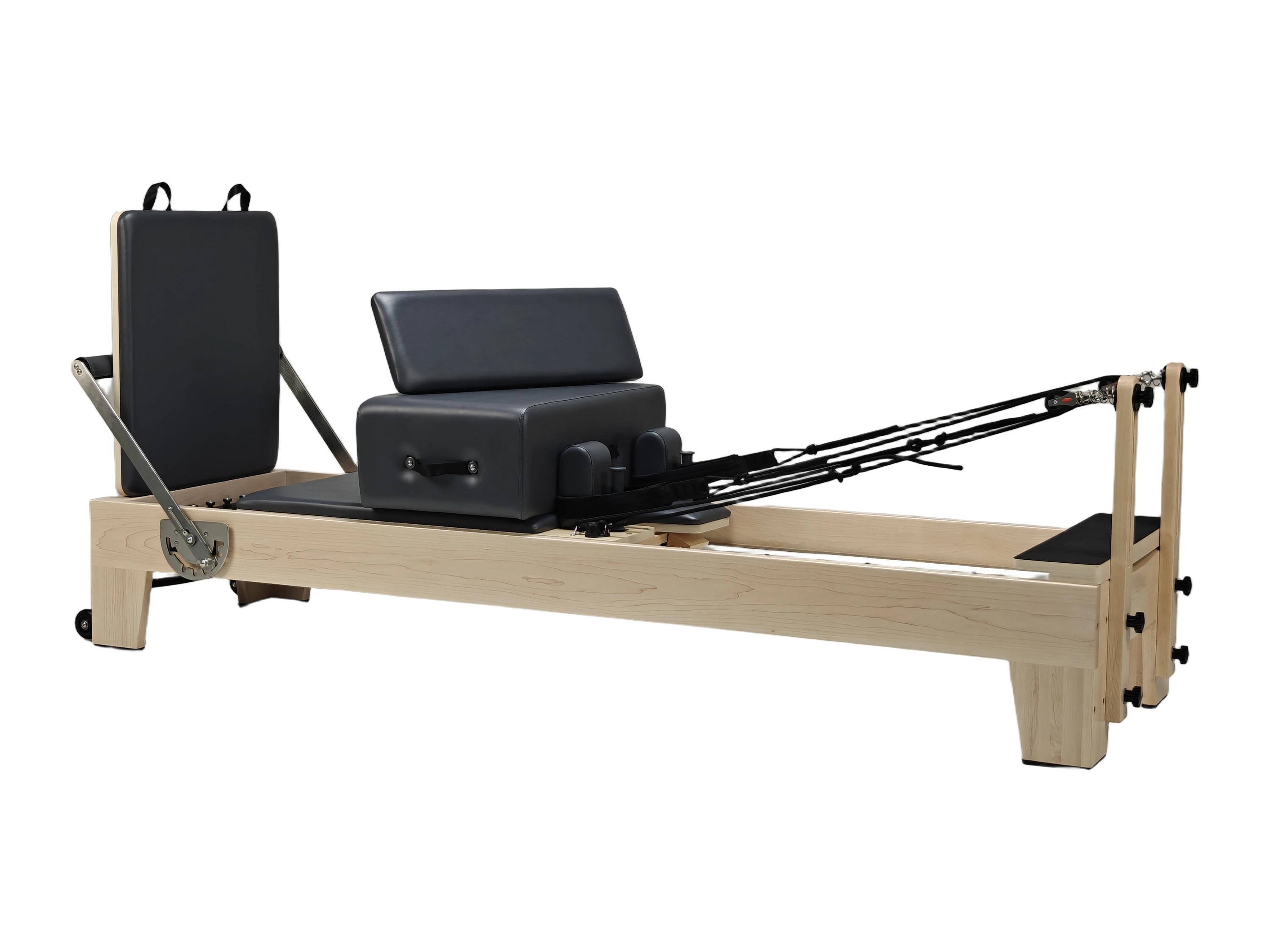
Reformer Pilates is used to practise controlled movement, strength, flexibility and balance with a spring-connected carriage. The apparatus gives an instructor options for changing support, resistance and body position. Its practical value is that a session can explore several movement patterns on one machine, with the setup chosen for the exercise and participant.
The NHS introduction to Pilates describes the method as exercise focused on balance, posture, strength and flexibility. Its guidance concerns Pilates generally. Reformer-specific results also depend on the exercise plan, instruction, starting point and consistency.
How the Reformer Changes an Exercise
A typical reformer has a carriage that moves along a frame, springs that connect to the carriage, and contact points such as a footbar and straps. The instructor selects a movement and setup. Depending on that setup, springs can resist movement or assist it; they are not a single fixed measure of difficulty.
For example, a participant might press the carriage away with the feet while practising a controlled return. Another exercise may use straps for arm or leg movement. The body position, spring arrangement, range and pace change what the participant has to do. Follow the equipment instructions and the instructor's setup rather than copying a spring colour or setting from another person.
What Reformer Pilates Can Help You Practise
- Strength through controlled movement: spring resistance can make selected movements more demanding while the carriage travels.
- Coordination and body awareness: controlling carriage speed and maintaining a chosen position gives the participant movement cues to work with.
- Mobility and flexibility practice: straps and supported positions can offer ways to move through a comfortable range. More range is not automatically better.
- Balance and postural control: some exercises ask the participant to organise the trunk and limbs while the carriage or straps move.
- Exercise variety: one apparatus can support different positions and movement patterns, provided the selected model and accessories are appropriate.
A useful way to discuss progress with your instructor is to ask whether you can control the same exercise more consistently, use a suitable range comfortably, or manage an agreed progression. Your wider routine may also include aerobic activity, other strength work or sport-specific practice.
What the Equipment Cannot Prove
A reformer does not automatically correct posture, prevent injury, build a particular body shape or treat pain. Describing a session as low impact also does not mean that every position is comfortable or appropriate for every participant.
A 2015 Cochrane review of Pilates for low back pain reported evidence of low to moderate quality and did not establish Pilates as superior to other exercise. That review does not establish treatment benefits for a specific commercial reformer. If pain, an injury, pregnancy or another health concern affects exercise choices, ask a qualified health professional and an appropriately trained instructor about a suitable plan.
Is a Reformer Right for Your Routine?
A reformer may suit someone who wants instructor-led apparatus work and has access to a suitable class or a space for the equipment. A mat session uses less equipment and can be easier to fit into a home routine. Neither option is automatically better; consider the instruction, exercises, space, budget and routine you can maintain.
For home use, measure the room with furniture in place and check the model's open dimensions and required exercise clearance. If storage matters, request the exact folded dimensions and approved storage position in writing; do not assume every folding model can be stored upright or under a bed. Our foldable reformer guide lists measurements and questions to ask.
Choosing Reformers for a Studio or Store
For a studio, retailer or distributor, start with the people who will use and maintain the equipment. Confirm intended use, adjustment range, the room layout, access route, accessories, setup instructions, replacement-part identification and written order terms. Ask suppliers to identify what is included in each configuration so quotes can be compared on the same basis.
For two starting points in the Atuspilates range, see the Maple Pilates Reformer (ATUSCC001) and Maple Folding Reformer with Telescopic Legs (ATUSHF001). Review the individual product pages and request confirmation of the selected model, configuration, dimensions and accessories for your use.
Shijiazhuang Atus Trade Co., Ltd. supplies Pilates equipment. Single-unit, sample and mixed-model enquiries are welcome. For a useful quotation, include your country, intended use, model or configuration of interest and quantity. The destination-specific delivery scope and order terms can then be confirmed in writing.
Send an equipment enquiry or contact us on WhatsApp. Include the room or studio context and questions you need answered; we will use those details to discuss suitable options.
Quick Questions
What is reformer Pilates good for?
It is a way to practise Pilates movements using a moving carriage and springs. Sessions can focus on controlled strength work, flexibility, coordination, balance and movement awareness. The result depends on the person and programme; no specific outcome is guaranteed.
Is reformer Pilates better than mat Pilates?
Not for everyone. A reformer adds spring resistance, a moving surface and more setup options. Mat Pilates uses little or no apparatus and requires less space. Choose based on your goals, access to instruction and preferred routine.
Can a beginner start with reformer Pilates?
Look for an introductory session that teaches carriage control, spring changes and getting on and off the apparatus. Ask what individual guidance is included, and tell the instructor about any health concerns before the session. Learning the setup is part of using the equipment.
What should I check before buying a reformer?
Confirm intended use, dimensions and clearance, adjustment and accessory configuration, assembly and storage instructions, access and handling, replacement parts and written order terms. For a folding model, request separate open, folded and packed measurements.
Choose equipment for your programme
Tell us your intended use, models and delivery destination. We can discuss configurations and freight options.