
PILATES EQUIPMENT GUIDE
What Is Reformer Pilates? A Beginner’s Guide to the Machine
A plain guide to the moving carriage, springs and straps — with questions to ask before your first class or your first equipment order.
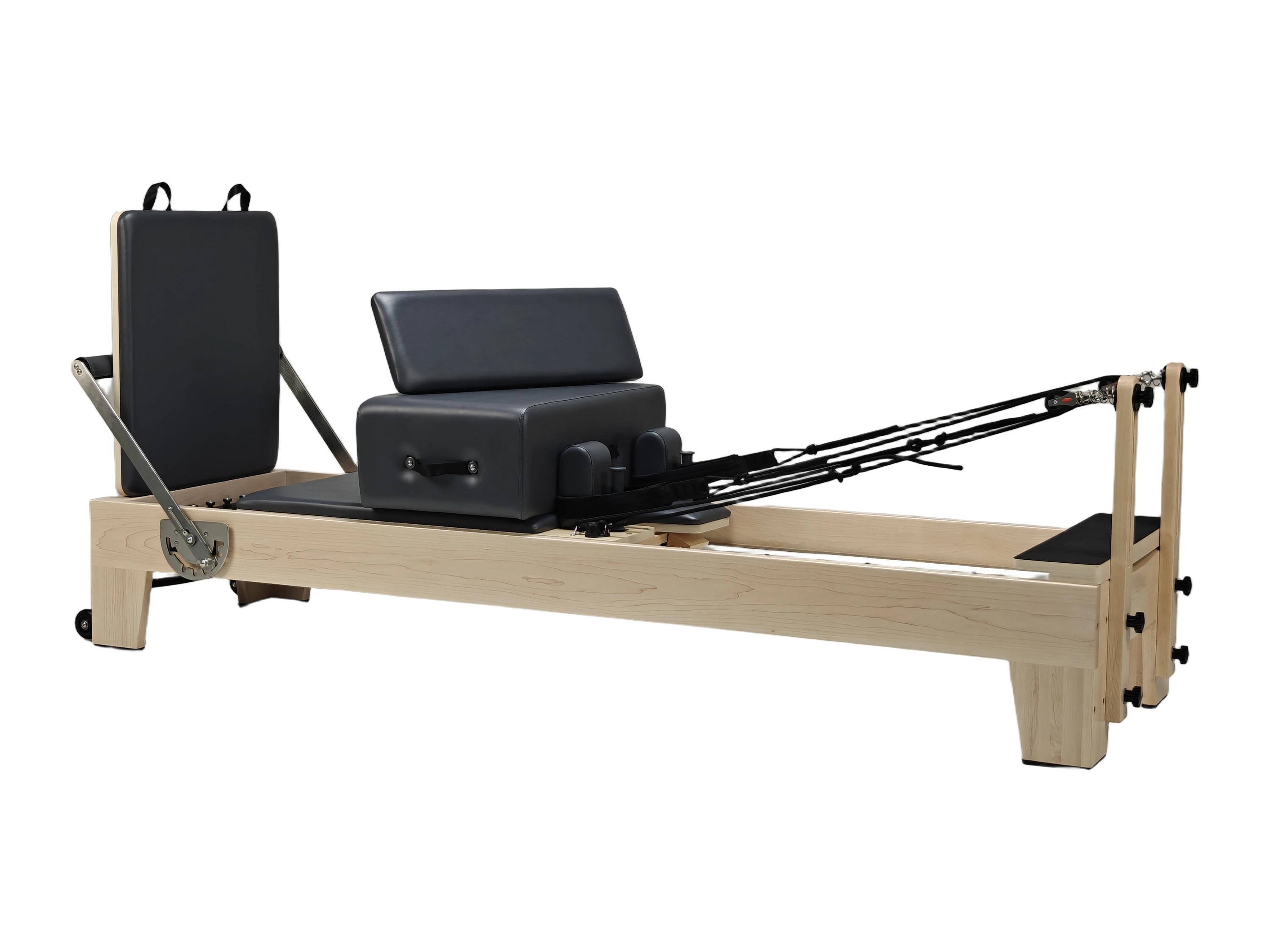
What Is Reformer Pilates?
Reformer Pilates is Pilates practised on a spring-based machine with a moving platform called the carriage. You move the carriage using the footbar or straps while controlling your body position. The instructor chooses exercises and equipment settings for the session.
The machine adds ways to work against resistance or receive support. It does not select your exercises for you. If you are new, learning how to get on, adjust the setup and return the carriage with control is part of the practice.
The Parts You Will See in a Class
- Carriage: the padded platform that travels along the frame.
- Springs: connect the carriage to the springbar and change the load.
- Footbar: provides a contact point for hands or feet in suitable exercises.
- Ropes and loops: connect movement of the arms or legs to the carriage.
- Shoulder rests and headrest: help position the body for relevant exercises.
Adjustments differ between machines. Ask the instructor to show you the locking points before changing anything; familiar-looking hardware may work differently on another model.
What Makes the Moving Carriage Different?
Imagine pushing the carriage away during a footwork exercise. You need to manage both the outward movement and the return. Pulling with straps gives another way to move the carriage, so the same apparatus can be used for different exercise patterns.
Springs may provide assistance or resistance depending on the movement. More springs are not a universal measure of difficulty, and fewer are not automatically easier. Ask why a setting is being used rather than copying the person beside you.
If you want to explore training outcomes, our reformer Pilates benefits guide explains what depends on the programme and instruction. A machine alone does not guarantee a particular result.
What to Check Before Your First Class
Choose a session that explicitly welcomes beginners. Tell the instructor what experience you have, and ask whether the booking includes an introduction to the machine. A class name or a photograph does not tell you how much setup guidance you will receive.
Follow the studio’s clothing and footwear policy. Close-fitting, stretchy clothing can stay clear of moving parts; secure hair and loose accessories. Ask about grip socks before arriving instead of assuming every studio has the same rule.
During the introduction, ask how the carriage is secured, where to step and which adjustments you should leave to the instructor. If you cannot hear or understand a cue, pause and ask. Do not try a standing exercise simply because you have seen it online.
Trying Classes Before Buying a Machine
A class can help you discover which adjustments you actually use. Afterwards, note practical observations: could you reach the footbar comfortably, did the straps fit, and was getting on and off manageable? Use those questions when comparing equipment; do not assume that every reformer has the same geometry.
For home use, draw the machine’s full working footprint on the floor and consider access around it. Check the delivery route through doors and stairs as well as the exercise area. If storage matters, compare open dimensions, folded dimensions and how the machine is moved. Our foldable reformer guide covers these decisions.
A studio has a different workflow: several people may need different settings between sessions. Ask for a demonstration of adjustments, cleaning access and replacement-part arrangements. For resale, request clear instructions your customer can use after delivery.
A Buyer’s Checklist Beyond the Product Photo
Ask for written answers before placing an order:
- What are the operating, storage and packaging dimensions for this configuration?
- Which accessories are included, and which require separate confirmation?
- What user limits and setup instructions apply to this model?
- How are replacement springs, ropes, wheels and upholstery identified and ordered?
- What will the pre-shipment inspection show, and what delivery scope is quoted?
A photograph can show the finish, but it cannot establish carriage travel, adjustment operation or how packed equipment reaches your room. Request a demonstration of the actual configuration and compare the written list with the quotation.
For starting points in our catalogue, see the Maple Pilates Reformer — ATUSCC001 and Maple Folding Reformer with Telescopic Legs — ATUSHF001. Confirm suitability and final configuration for your intended use rather than choosing on appearance alone.
Questions Beginners Ask
Is Pilates reformer better than mat?
Neither is the better choice for everyone. Mat Pilates needs less equipment; a reformer adds carriage and spring-based exercise options. The useful choice depends on the instruction, routine and space you can maintain. See our mat Pilates vs reformer comparison for the practical differences.
Can a beginner use a reformer?
A suitable introductory session can teach the setup and basic movement. Starting with instruction is different from trying to copy advanced exercises alone. Check the class level and ask what guidance is provided.
Is a compact Pilates board the same machine?
Check the mechanism rather than the name. A compact board with elastic bands can differ from a full carriage-and-spring reformer. Compare the movement and dimensions in our mini versus full-size reformer guide.
Do I need a tower to start?
A tower is an additional set of exercise options, not a requirement for every session. Ask your instructor which apparatus your programme needs before adding accessories to a purchase.
Planning Equipment for Your Home or Business?
Shijiazhuang Atus Trade Co., Ltd. is a Pilates equipment trading and supply company. Single units, samples and mixed-model orders are welcome. Tell us your intended use, models and destination through the inquiry form.
Direct orders use a 30% deposit by bank transfer (TT), with a proforma invoice before payment. You check your order’s pre-shipment QC video before paying the balance and dispatch. DDP delivery is available to most countries, with customs clearance, import duties and door delivery included in the confirmed scope. We confirm destination availability in the quotation; EXW, FOB, CNF and FCA are also available.
Choose equipment for your programme
Tell us your intended use, models and delivery destination. We can discuss configurations and freight options.